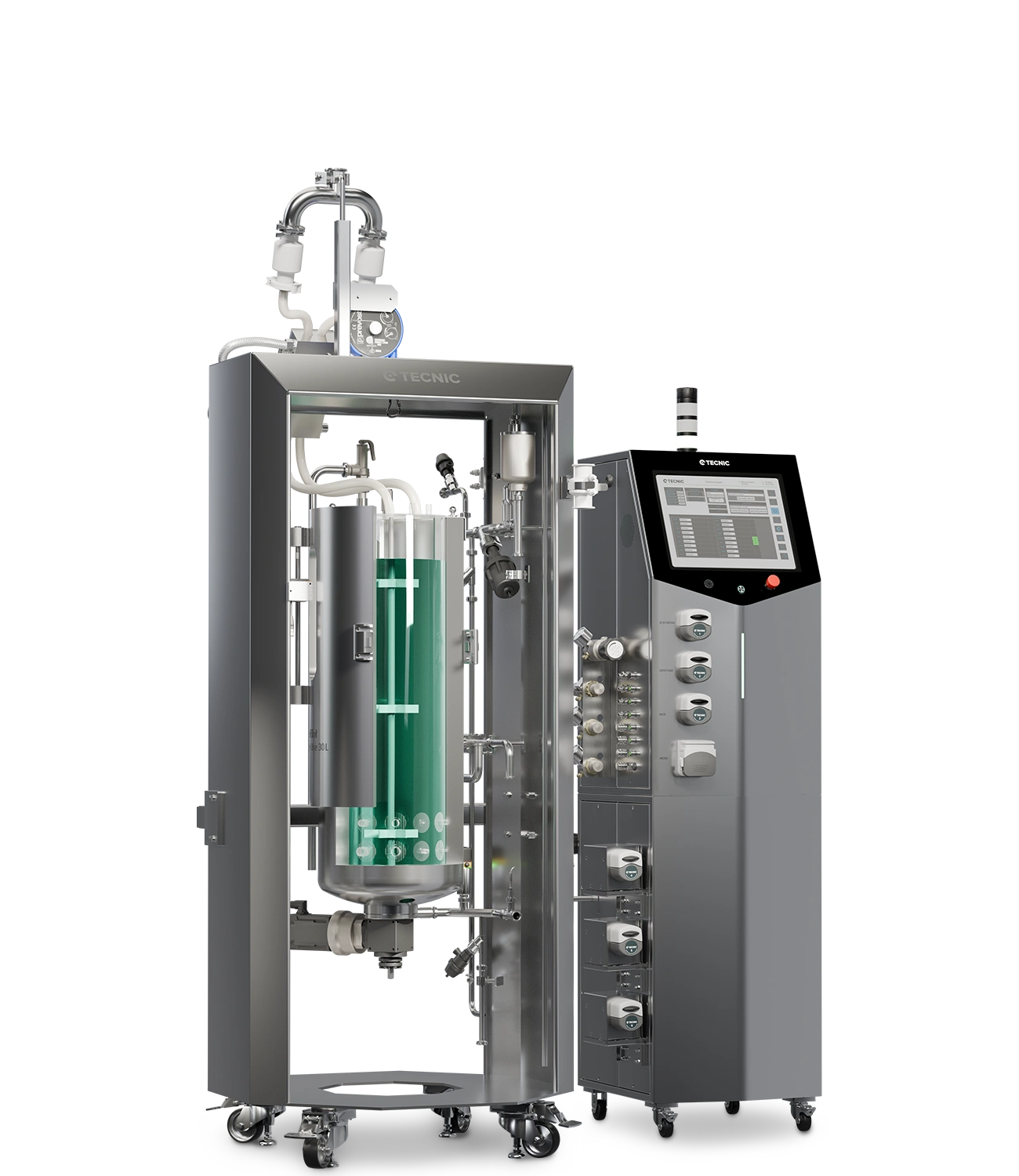
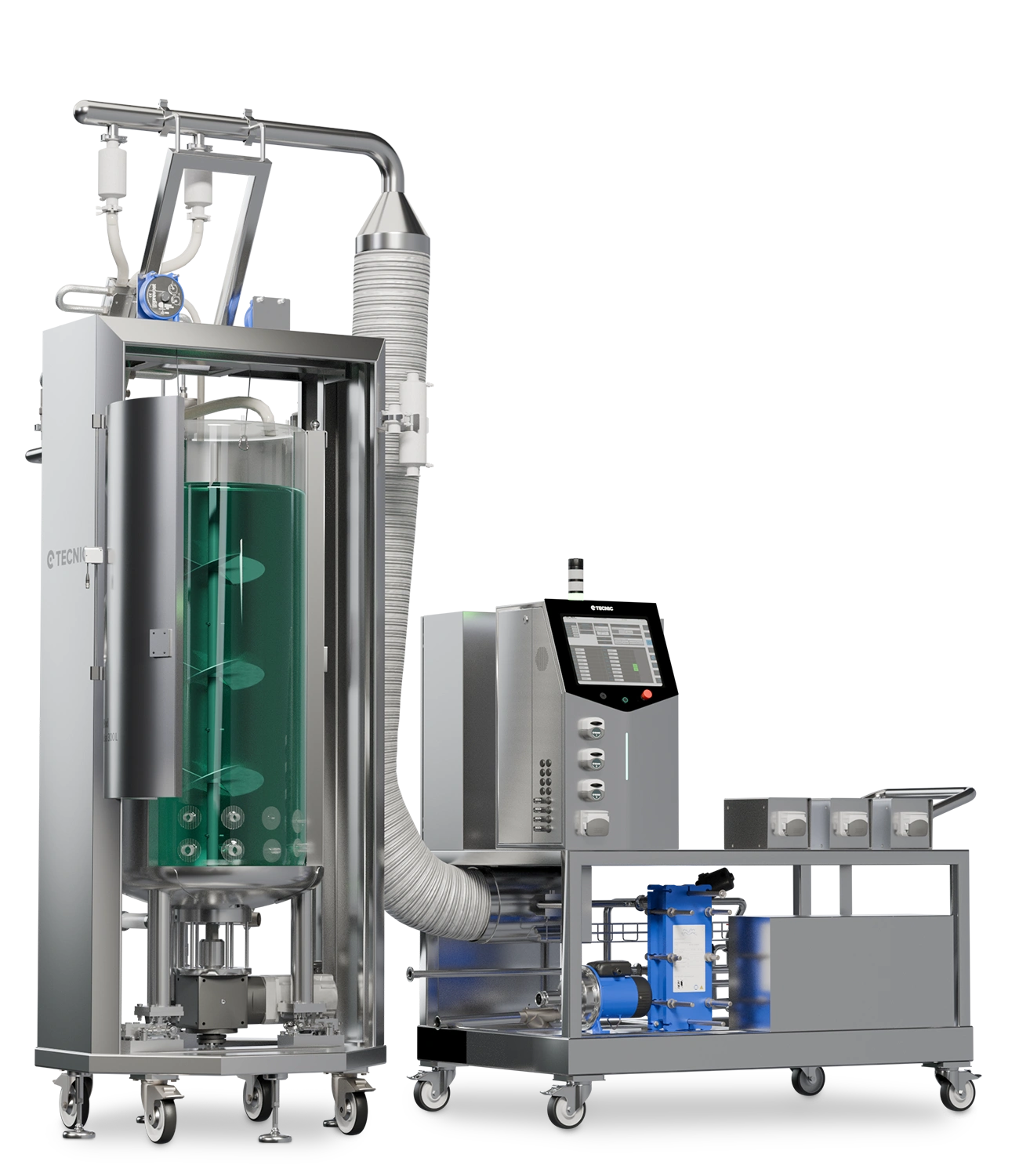
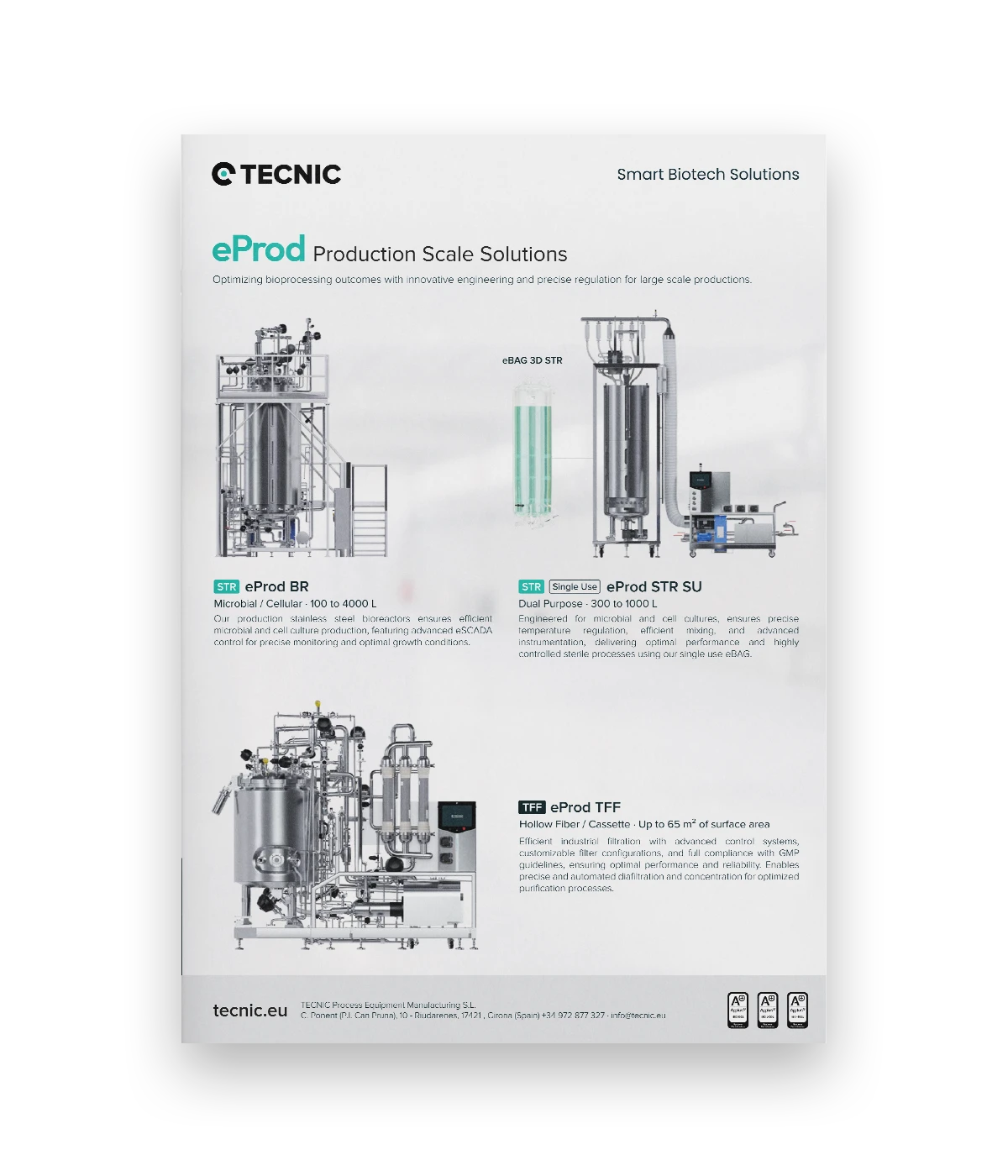
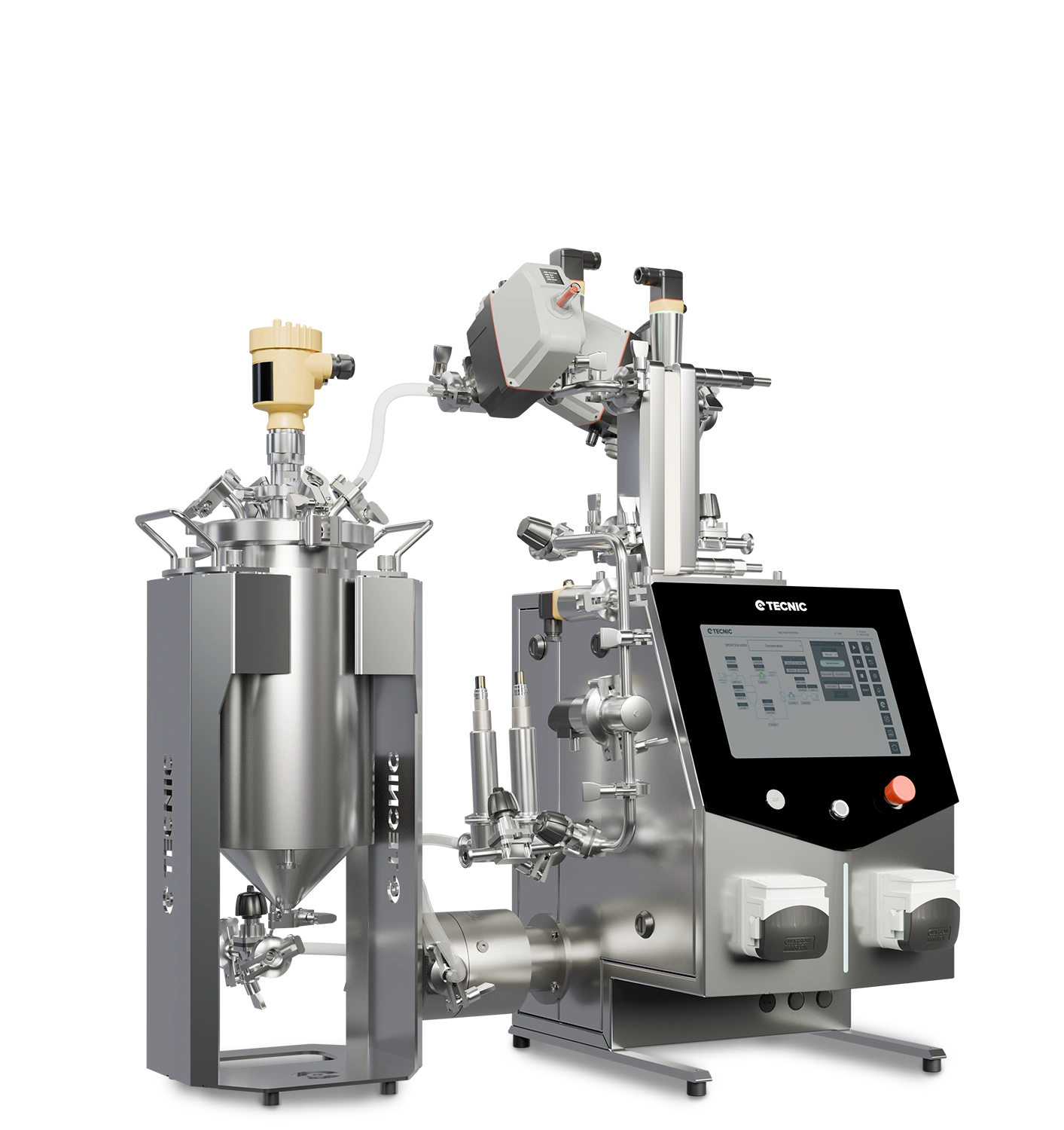
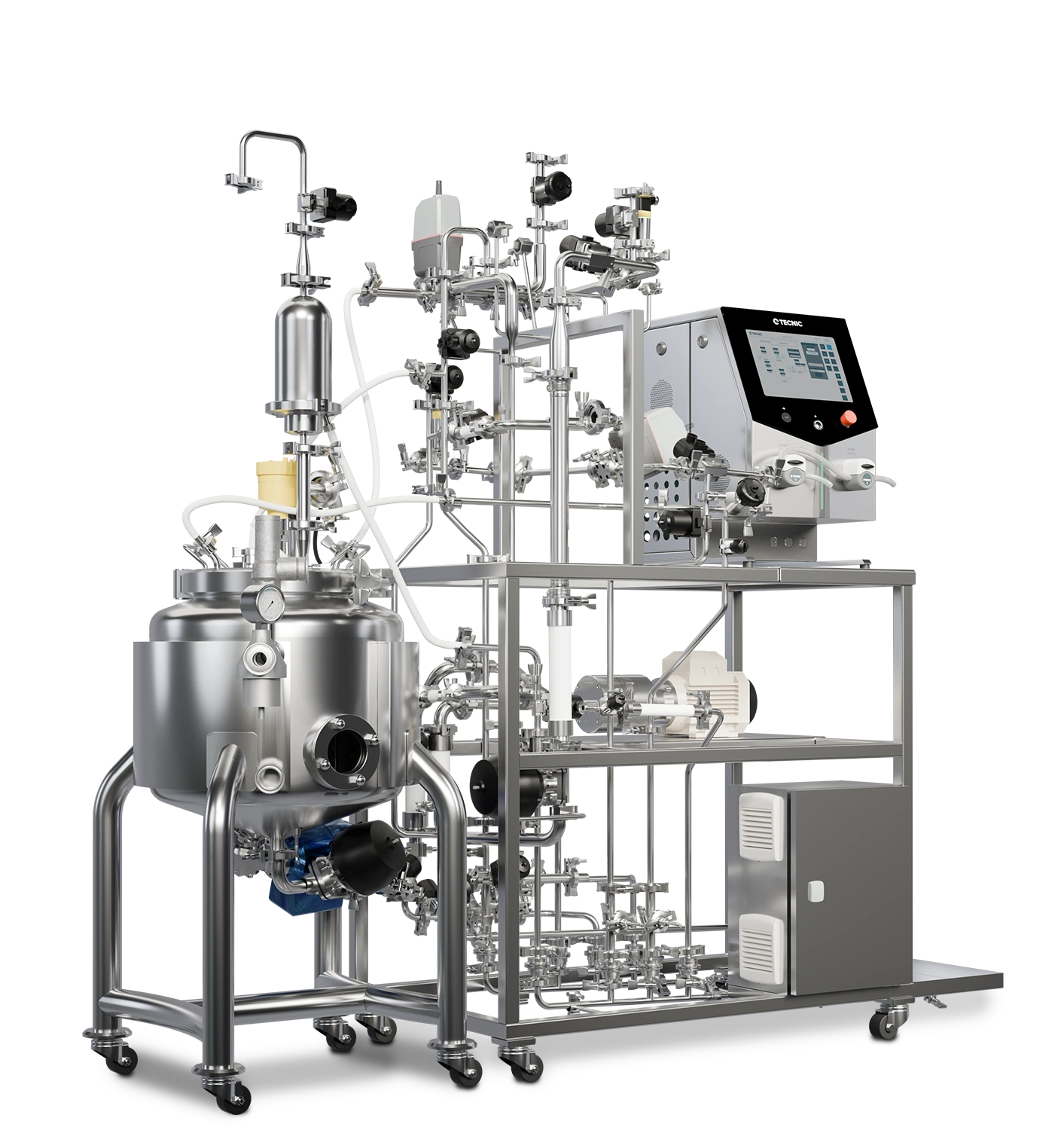
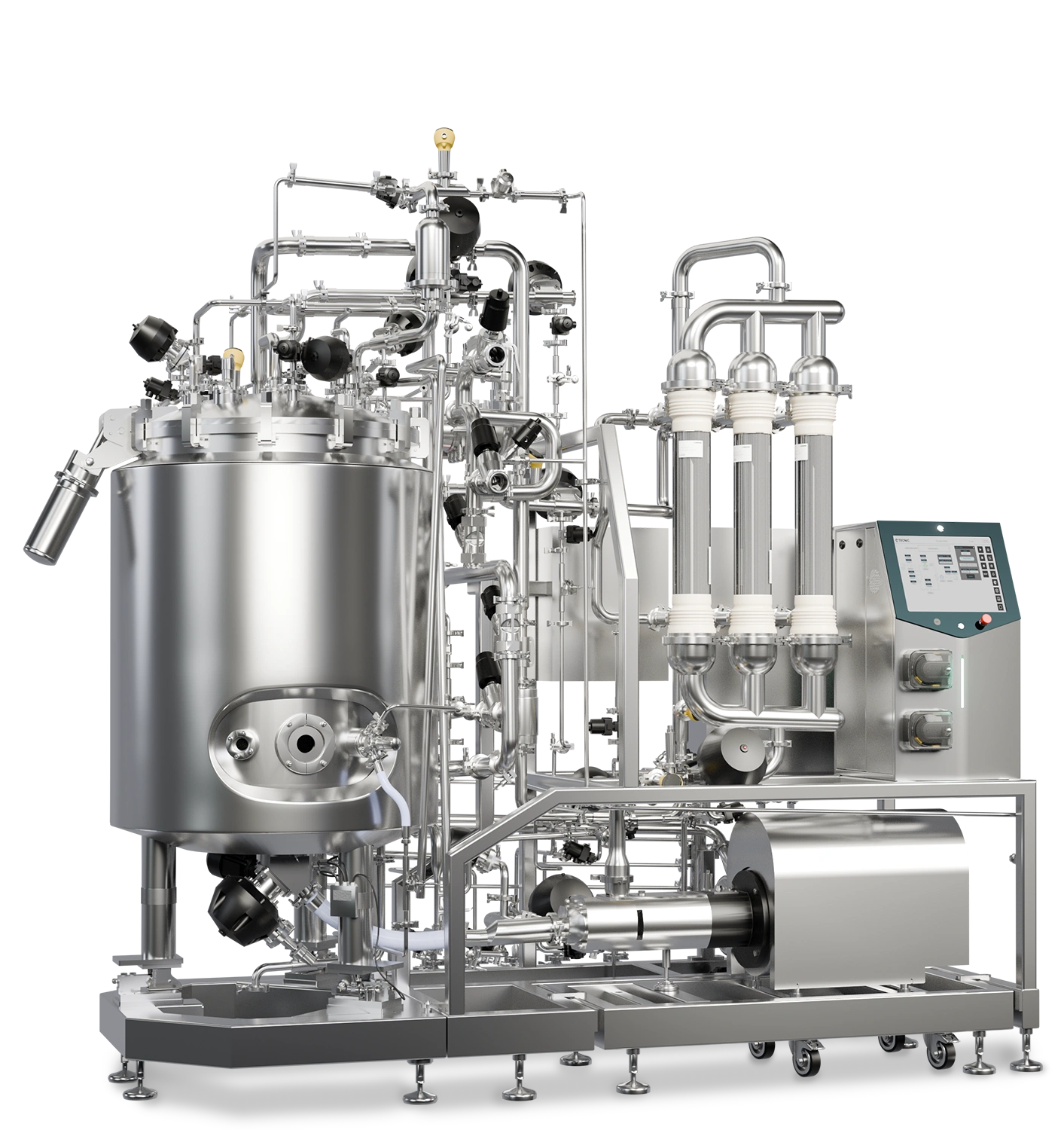

eProd Tangential Flow Filtration
Automated tangential flow filtration for concentration, diafiltration and buffer exchange, with TMP and ΔP control.
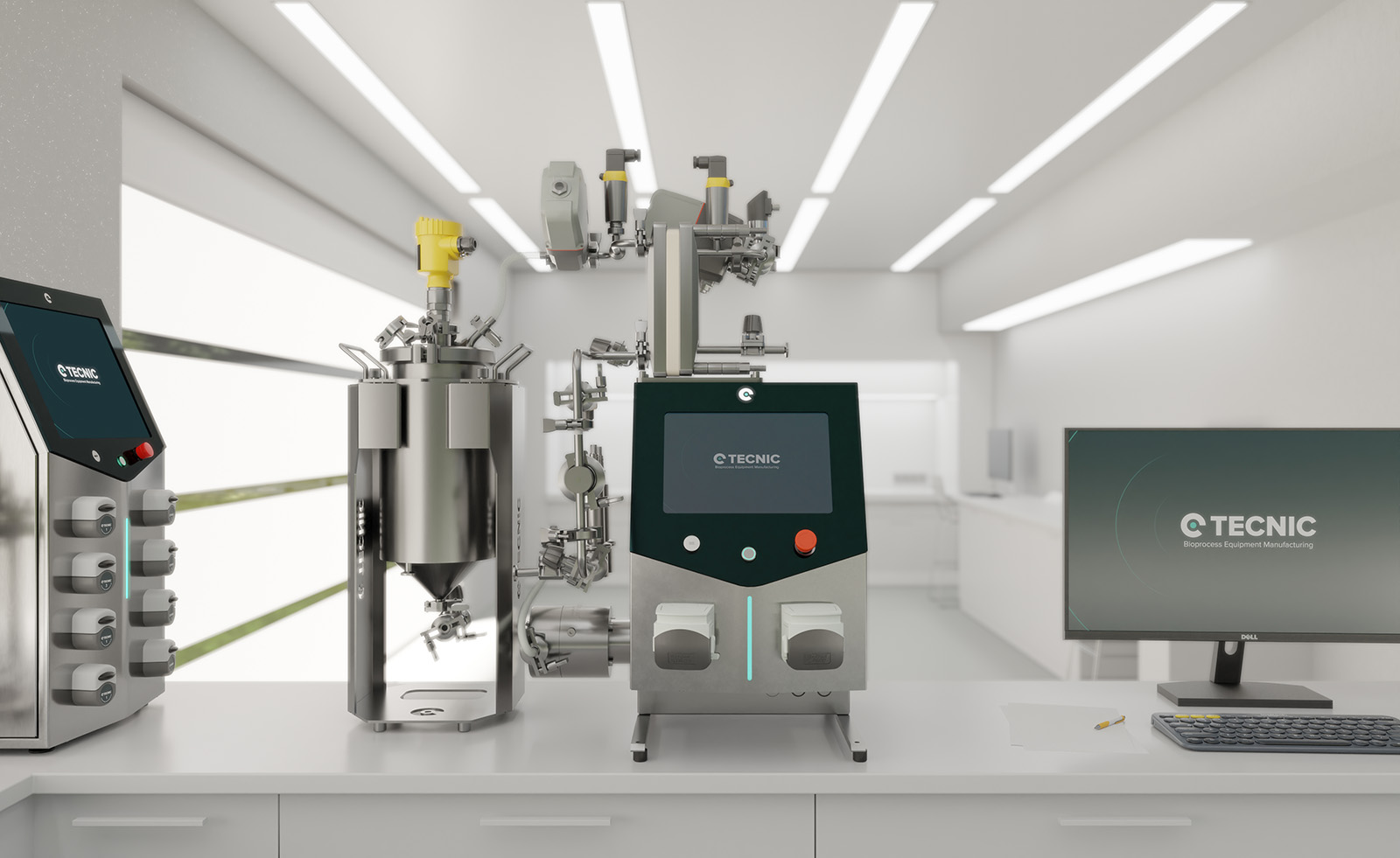
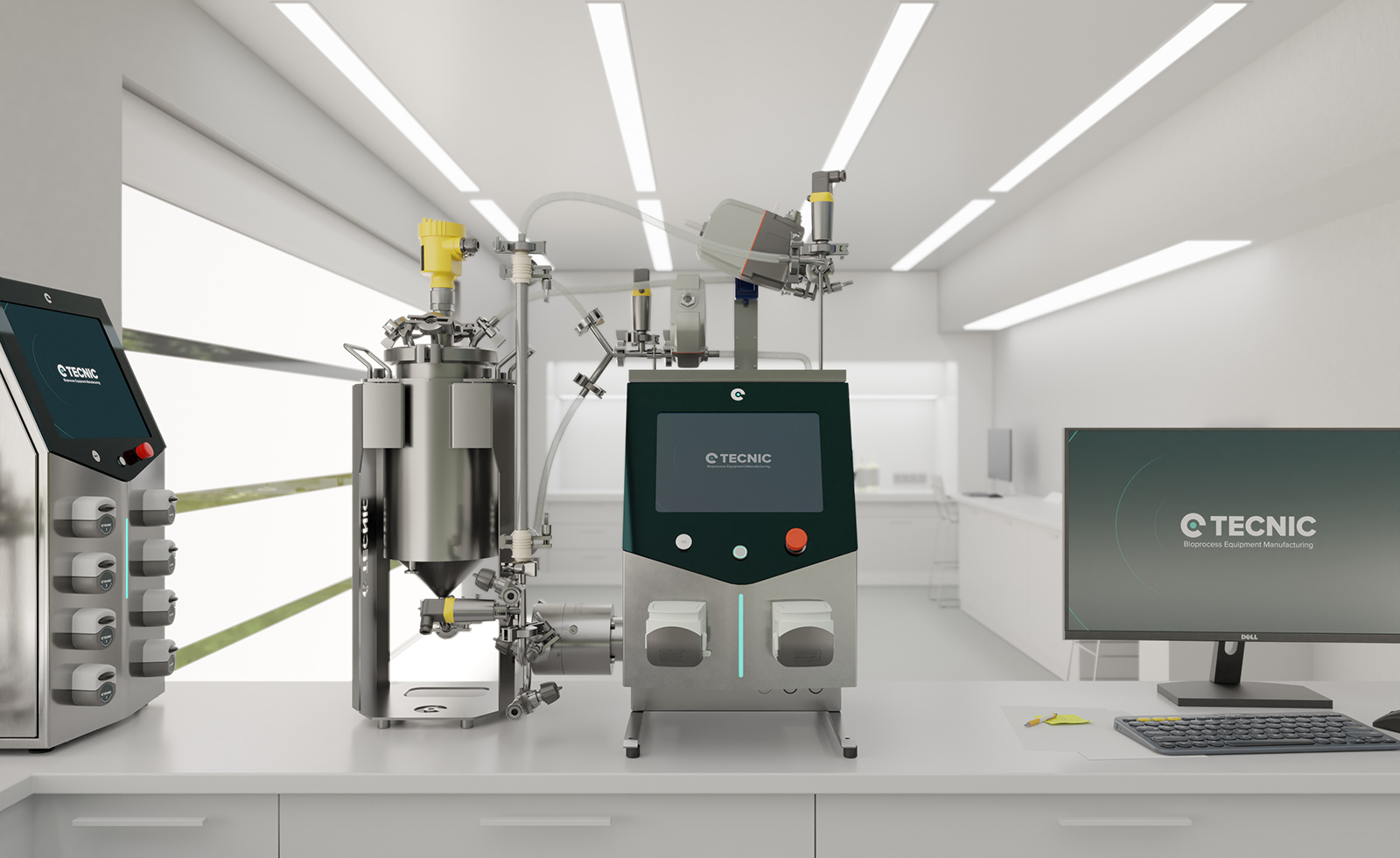
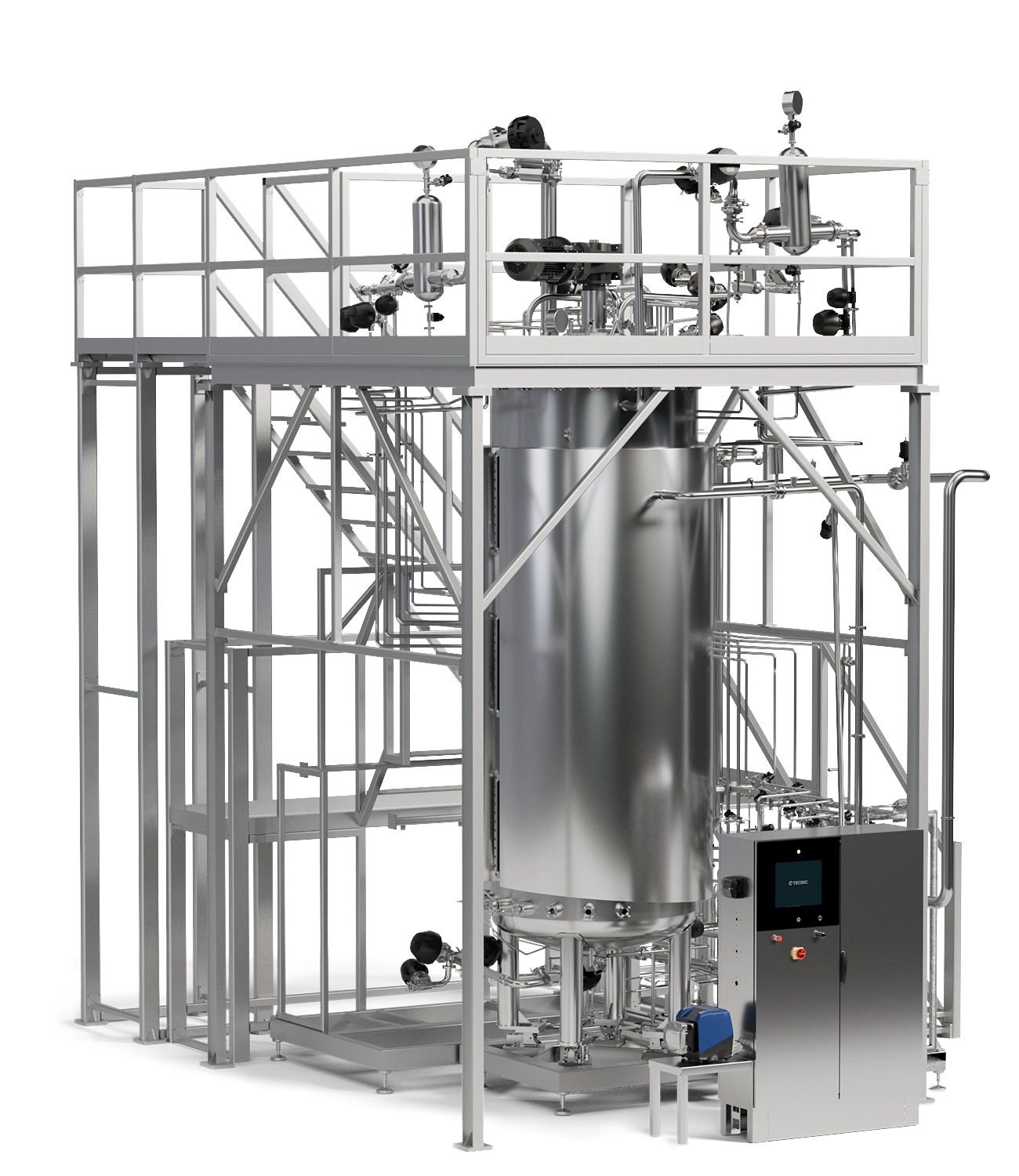
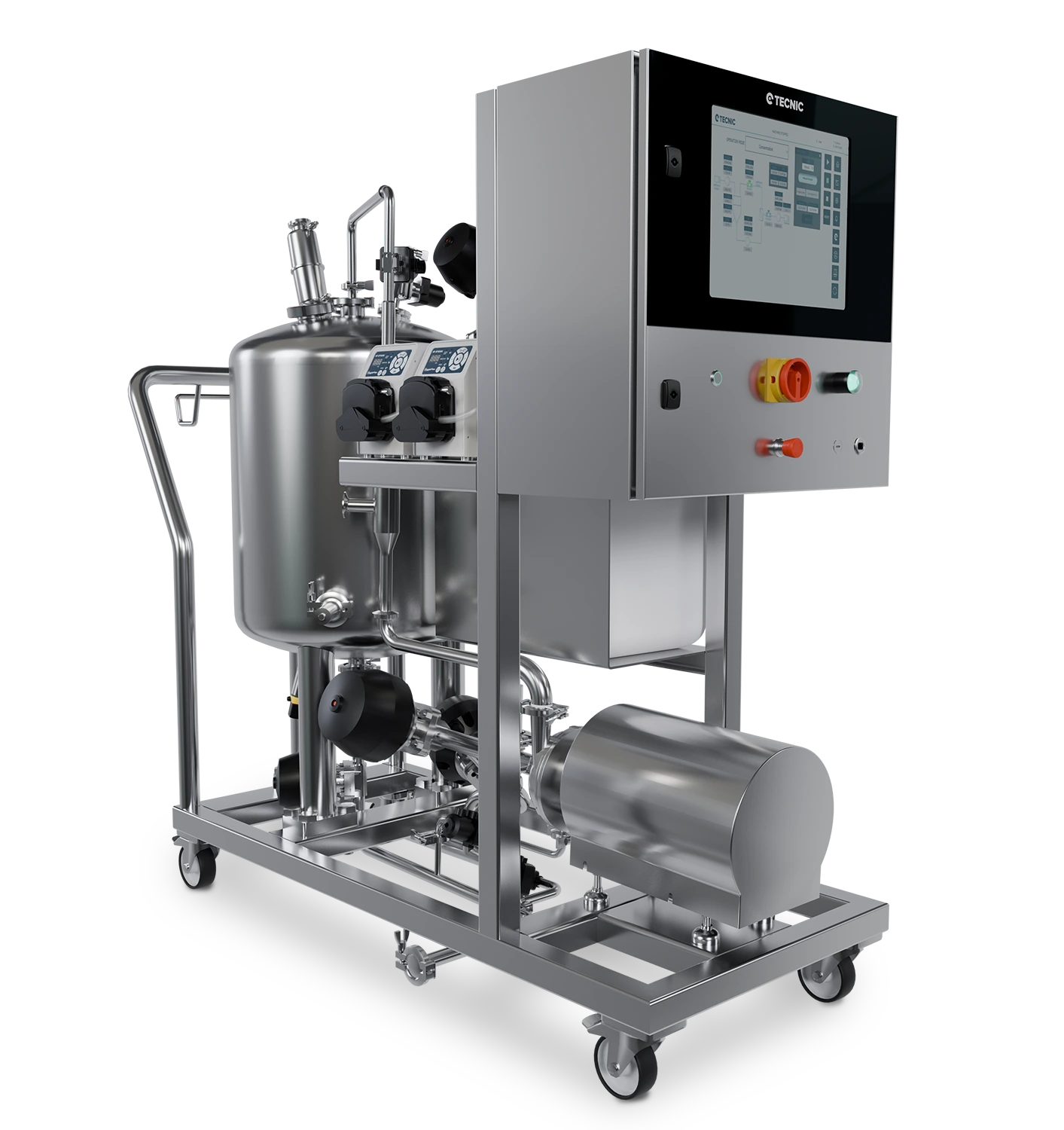
eProd TFF is a tangential flow filtration platform designed for industrial concentration, clarification and/or buffer exchange operations using diafiltration, with a high level of automation. This version integrates a stainless steel tank, online instrumentation and a control system PLC + HMI/eSCADA that allows operation with control strategies based on TMP, flow rate and pressure limits (ΔP), as well as recipes, traceability and reporting.
The system is compatible with different membrane formats (cassette, hollow fibre and, optionally, ceramic/tubular modules) and can cover microfiltration, ultrafiltration and nanofiltration* processes depending on the membrane and housing installed.
* Nanofiltration depends on the availability of modules/membranes in the selected format and their compatibility with the housing.
ePilot Tangential Flow Filtration
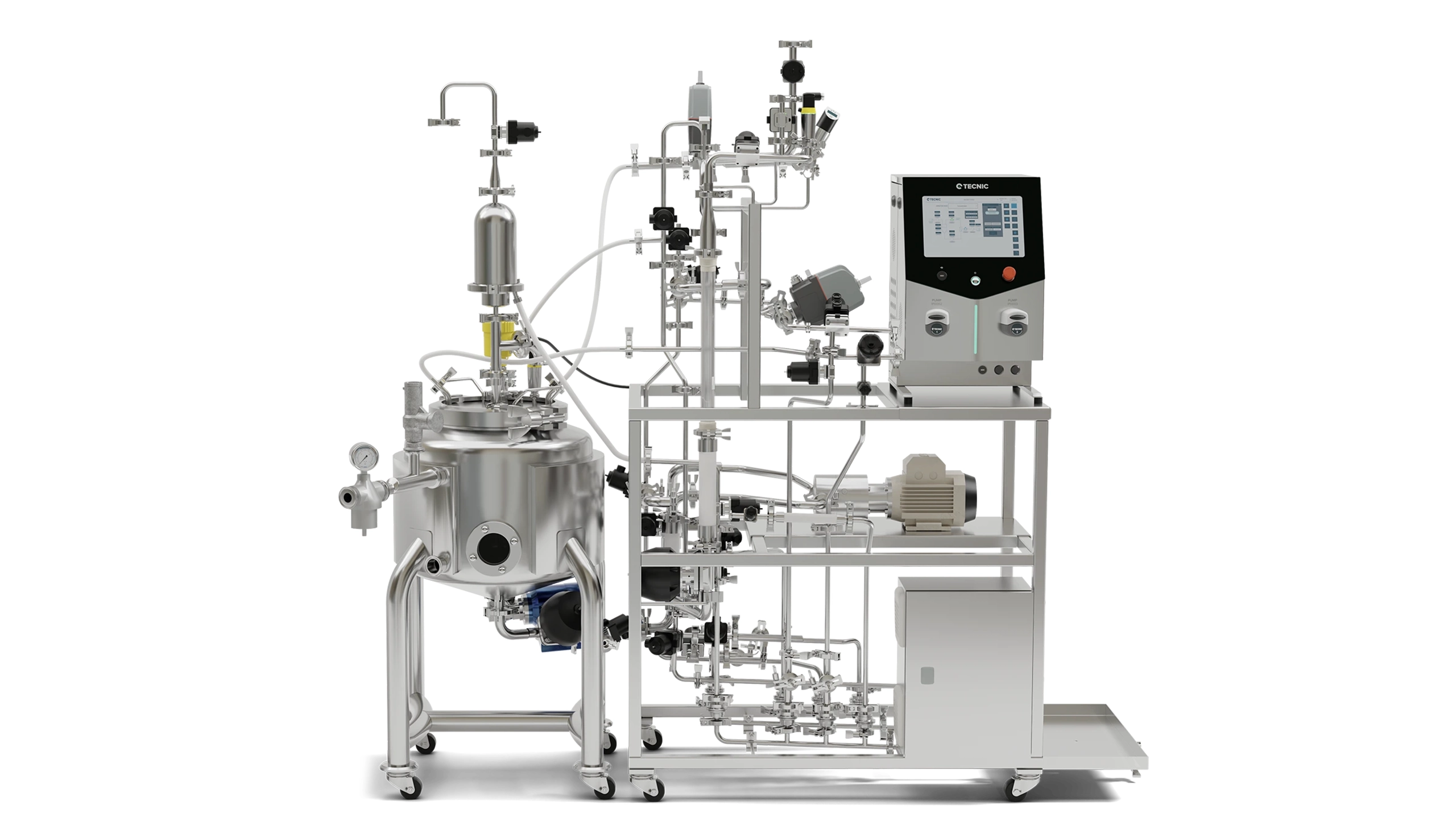
Pilot scale tangential flow filtration system for concentration, diafiltration and clarificationa.
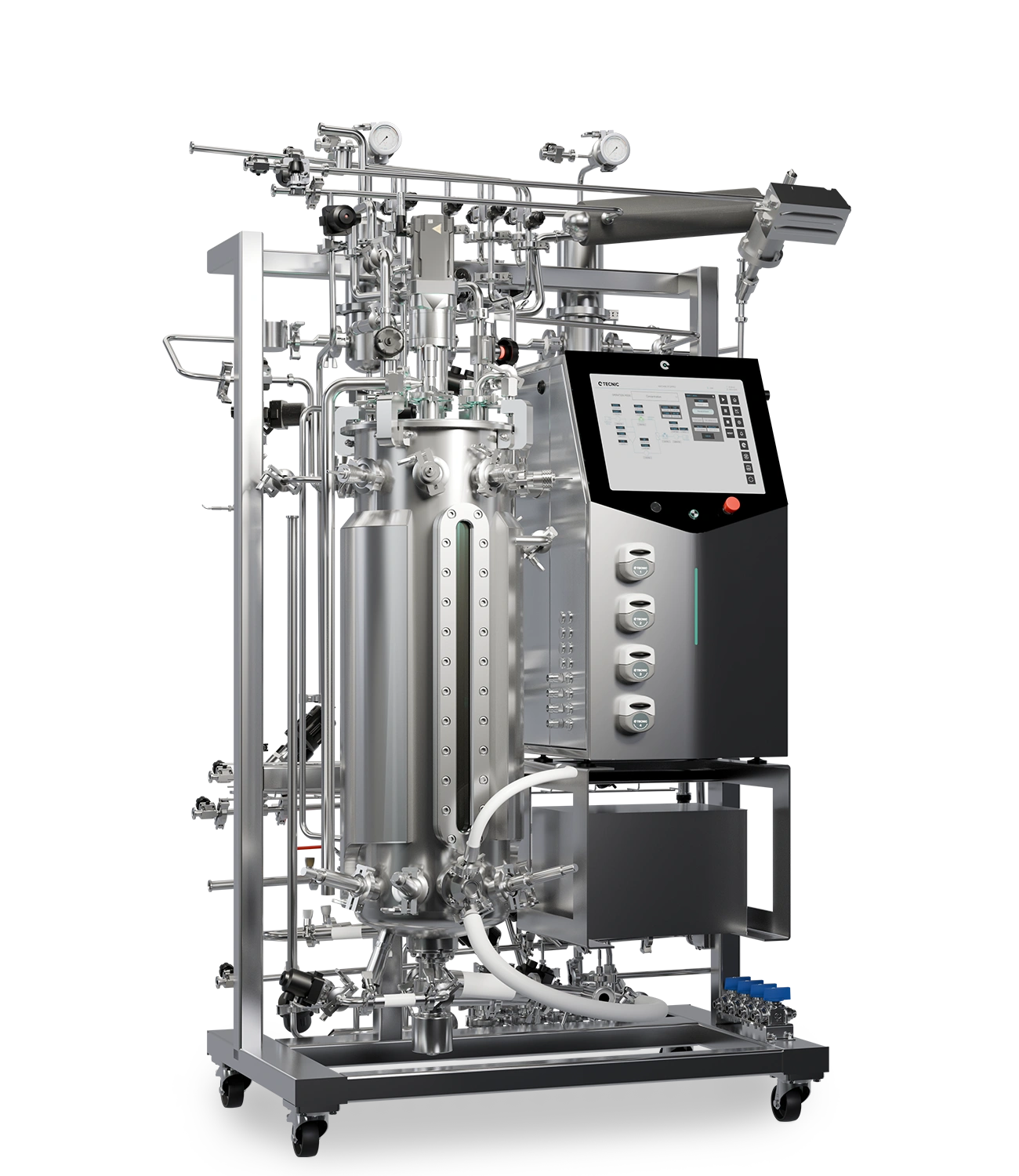
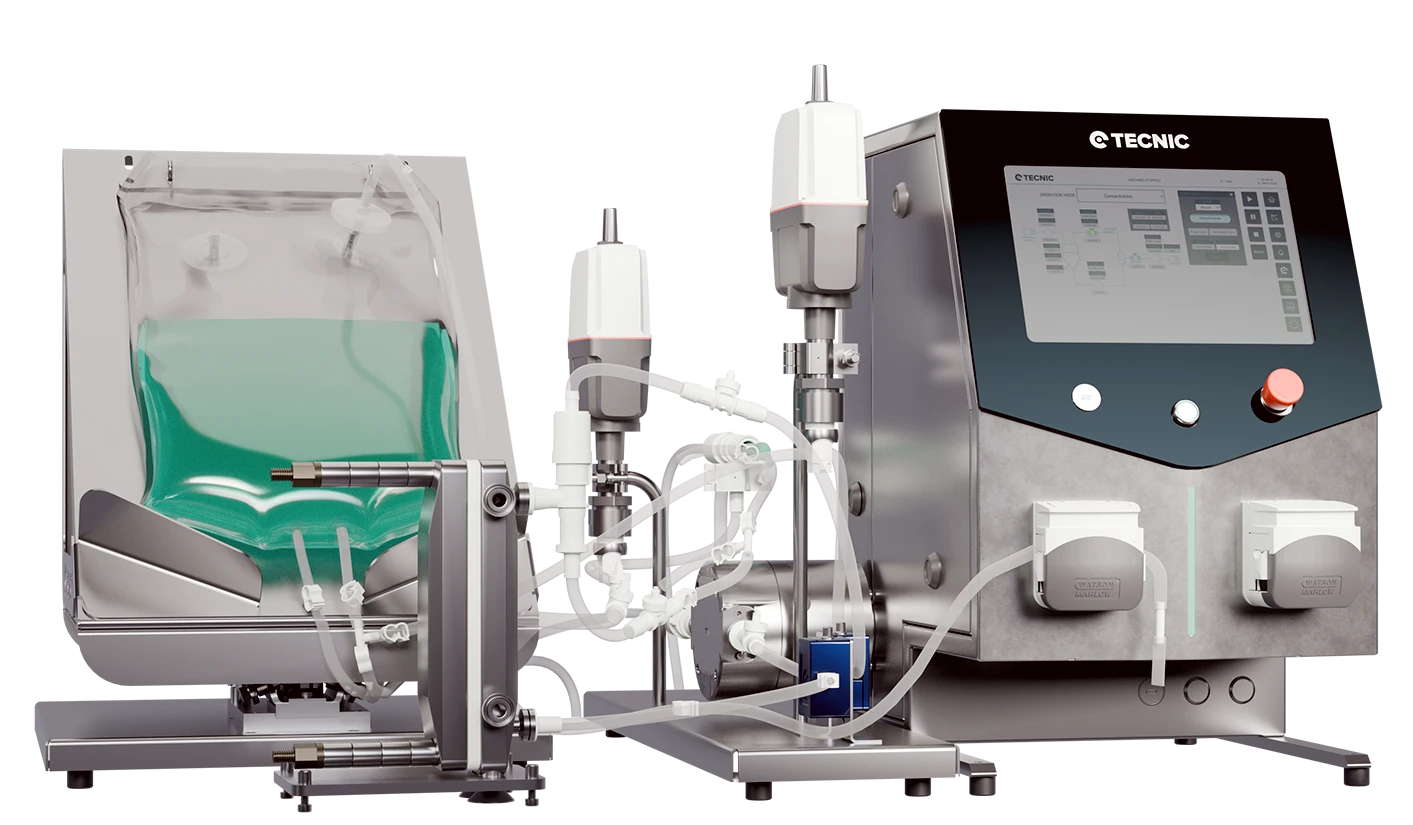
The ePilot TFF is a pilot scale tangential flow filtration system designed for recovery and purification in bioprocesses. It supports microfiltration, ultrafiltration and nanofiltration, with automatic control by TMP, ΔP and flow, plus integrated modes for concentration, diafiltration, water flux test, CIP and SIP, depending on configuration. The platform is structured around a process skid, control tower, product tank and membrane support for cassette or hollow fibre formats, helping teams move from process development to pilot scale with a more controlled and repeatable workflow.
Flexibility across TFF membrane formats
• Concentration and diafiltration of biomolecules
• Clarification and turbidity reduction
• Buffer exchange (diafiltration at constant or variable volume)
• Processes with traceability, control and reporting requirements
• Separation processes with specific membranes
Process modes and control strategies
Membrane formats and compatibility
Automation, HMI and data handling
Standard scope and plant-ready options
Main specifications
The ePilot TFF is a pilot scale tangential flow filtration system designed for recovery and purification workflows from 50 to 200 L. The platform supports microfiltration, ultrafiltration and nanofiltration, with cassette and/or hollow fiber modules depending on configuration, and automatic control based on TMP, ΔP and flow to support more repeatable pilot-scale operation.
| Parameter | Value / description |
|---|---|
| Working volume | 50 to 200 L (50 L standard; other sizes on request) |
| Filtration technologies | Microfiltration / Ultrafiltration / Nanofiltration (depending on membrane) |
| Module type | Cassettes (flat-sheet) and/or Hollow Fibre (depending on version) |
| Membrane area (cassette) | 0.5 to 2.5 m² (max. in pilot configuration) |
| Membrane area (hollow fibre) | 0.1 to 6.5 m² (max. in pilot configuration) |
| Recirculation / crossflow | Up to 1.2 m³/h (standard); optional high flow rate up to 2.3 m³/h (depending on configuration) |
| Operating pressure | Up to 4 barg (cassette) / up to 2 barg (hollow fibre), depending on configuration |
| Dead volume (minimum, without membrane) | ≈ 0.5 L (draining design; depends on configuration) |
| Dimensions | ≈ 1573 (W) x 1800 (H) x 550 (D) mm (depending on layout) |
| Weight | ≈ 50 kg (standard configuration; depends on options) |
| Pump speed | Fixed ≈ 190 rpm / Variable ≈ 230 rpm (depending on pump/version) |
| Materials in contact with product | AISI 316L (typical); elastomers according to project |
| Automation | Automatic modes: concentration (TMP/ΔP/constant permeate), diafiltration, filling, water flux test, CIP and SIP (depending on configuration) |
| HMI / software | Touch screen + eSCADA; recipes and data management (depending on version) |
| Communications | Ethernet; OPC server for integration (tags to be defined per project) |
Features of ePilot TFF System
The final configuration may vary depending on the scope of supply, options installed and country of destination. For final sizing, use the quotation and nameplate of the equipment supplied.
Dimensional data
| Subsystem | Operating pressure | Max. PS (design) | Max. TS (reference) | Notes |
|---|---|---|---|---|
| Process circuit (filtration) | Variable (depending on mode) | 4 barg (cassette) / 2 barg (HF) | Up to 121 °C (SIP), depending on configuration | Controlled by pressure and flow loops; overpressure protected according to design. |
| Product tank (50-200 L) | ATM (typical) | Depending on project configuration | According to process, CIP/SIP if applicable | Typical non-pressurised operation; confirm limits on GA and equipment plate. |
| CIP (self-cleaning) | Variable | Depending on configuration | Depending on cleaning agent and temperature | Automatic sequences with user-defined parameters. |
| SIP (sterilisation) | Variable (steam) | Depending on configuration | 121 °C (typical) | Automatic SIP with clean steam; requires utilities and site conditions. |
Final PS and TS values must always be confirmed in the project compliance documentation and on the equipment plate.
Series, options, and recommended configuration
What comes standard
• 50 L tank (standard) with drainable design and process connections.
• Membrane support for cassette (0.5-2.5 m²) or hollow fibre (0.1-6.5 m²), depending on version.
• Automatic concentration and diafiltration control, with regulation by TMP, ΔP and/or flow, depending on mode.
• Crossflow and recirculation control with flow measurement and setpoint management.
• Water Flux Test mode for verifying membrane recovery after cleaning.
• Automatic CIP (Cleaning-In-Place) for cleaning the circuit and tank.
• Automatic SIP (Sterilisation-In-Place) when the option is installed and utilities are available.
• Touchscreen HMI + eSCADA with trends and alarms, with data logging depending on version.
• Ethernet + OPC server for external integration.
Available options, depending on scope
• Other tank sizes (50-200 L) and material options, depending on project.
• Cassette holder with adapters compatible with manufacturers such as Sartorius, Repligen, Merck-Millipore, and Pall.
• Hollow fibre version and accessories, depending on module geometry.
• High-flow pump (for example, lobe pump) for increased crossflow and recirculation, up to 2.3 m³/h depending on configuration.
• Optional instrumentation: pH (0-14), conductivity (1 µS/cm to 300 mS/cm), additional temperature, and more.
• Software packages with extended recipes, automatic reports, and user management or audit trail, depending on version.
• Industrial remote access, optional and subject to customer IT/OT policy.
• GMP/CSV and IQ/OQ documentation packages, optional and available on demand.
Recommended minimum configuration for plant use
Recommended minimum configuration for pilot operation in plant, to be validated according to URS and process:
• OPC-enabled server with definition of minimum tags for historian or SCADA.
• pH and conductivity instrumentation if the process includes diafiltration with end-point criteria based on conductivity or pH.
• Recirculation pumping sized to the target crossflow, standard 1.2 m³/h, with high-flow option available.
• Cleaning plan (CIP) validated for the chosen membrane and, if applicable, SIP with steam utilities available.
Performance and filtration capacity
Filtration performance, including permeate flow, retention, and fouling behaviour, depends on the selected membrane, effective area, product formulation, temperature, viscosity, and operating strategy. The references below help align operating criteria and test routines across typical pilot-scale workflows.
• ΔP (pressure differential): ΔP = P_feed - P_retained.
• TMP (transmembrane pressure): TMP = ((P_feed + P_retained) / 2) - P_permeate.
• Crossflow / recirculation: flow rate in the retentate loop, measured by flow meter.
• Permeate flow (Qp): permeate outlet flow rate, which can be regulated by pump or valves depending on configuration.
• Flow balance in diafiltration (constant volume): Q_DF (addition) ≈ Qp (permeate), so ΔFlow = Q_DF - Qp ≈ 0.
| Mode | What it regulates | Typical use |
|---|---|---|
| Concentration by TMP | Maintains constant TMP by acting on valves and pressures. | Robust and controlled operation, useful in ultrafiltration, nanofiltration, and pressure-sensitive products. |
| Concentration by ΔP | Maintains constant ΔP to protect the membrane channel. | Reduces risk of compaction or damage when differential pressure must be limited. |
| Concentration by constant permeate | Maintains constant Qp and adjusts feed pressure in response to fouling. | Maintains productivity and is commonly combined with maximum TMP or PS alarms. |
| Diafiltration | Maintains constant volume while replacing buffer, with addition equal to permeate. | Buffer exchange and reduction of salts or impurities, combined with previous modes. |
| Automatic filling | Level or volume control in the tank. | Repeatable loading of product or diafiltration solution. |
| Water Flux Test | Membrane recovery verification routine. | Post-CIP comparison against a reference as a cleanliness indicator. |
| CIP / SIP | Automatic cleaning and sterilisation sequences, depending on configuration. | Supports repeatability and helps reduce disassembly and changeover time. |
Membranes and compatibility
Module types
- Cassette (flat-sheet): typical area from 0.5 to 2.5 m², suitable for precision in pilot scale-up.
- Hollow fibre: typical area from 0.1 to 6.5 m², suitable for higher throughput and scalability.
Compatibility with cassettes from different manufacturers
The system can be supplied with adapters for mechanical compatibility with cassettes from different manufacturers, including, depending on scope, Sartorius, Repligen, Merck-Millipore, and Pall.
Consumables documentation and traceability
Consumable documentation for membranes, filters, and tubing is provided according to contract and supplier availability. This may include certificates of conformity, technical data sheets, batch traceability, and, where applicable, declarations of materials and extractables/leachables.
Automation and software
Operating modes and how they work
- Crossflow control: the recirculation flow rate is regulated through pump speed in the retentate loop, using feedback from the flow meter.
- TMP control: the system calculates TMP with pressure transmitters and acts on proportional and/or backpressure valves to maintain the setpoint.
- ΔP control: the system keeps the differential pressure within the defined limit by adjusting pump speed and/or valves.
- Constant permeate: Qp is set and the system compensates for fouling by increasing pressure within the defined safety limits.
- Diafiltration: the system maintains constant volume or level by balancing buffer addition (Q_DF) with permeate withdrawal (Qp).
- Water Flux Test: water-based routine used to measure permeability and compare results against the post-cleaning reference.
- CIP: multi-stage cleaning sequence, including rinsing, recirculation, and backwashing according to recipe, with configurable repetition.
- SIP: steam sterilisation sequence including preparation, heating, sterilisation, and cooling, when installed and utilities are available.
HMI/eSCADA screens
The ePilot TFF System can be equipped with an eSCADA interface for process supervision, parameter configuration, trends, alarms, and cleaning or sterilisation sequences, depending on software version and project scope.
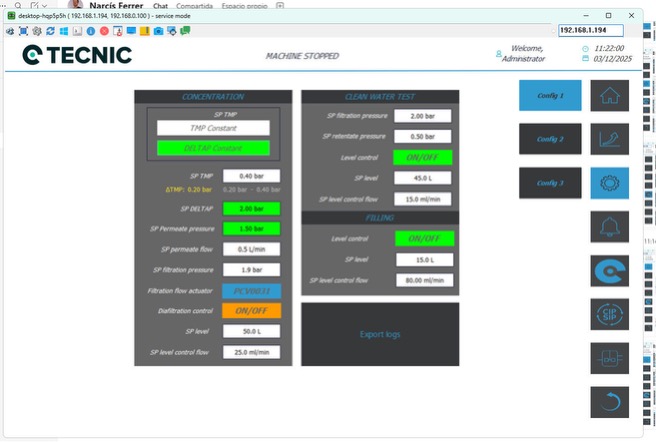
Example of eSCADA interface, configuration screen with TMP, ΔP, permeate, and diafiltration setpoints.
Typical functions, depending on version, include equipment status, main PV and SP values, trends, alarms, process configuration, log export, and CIP or SIP screens.
| Screen | What it shows | Typical use |
|---|---|---|
| Overview / Main | Process diagram, PV/SP values, pump and valve status. | Daily operation and supervision. |
| Configuration | Process parameters by mode, including TMP, ΔP, Qp, level, and flow rates. | Campaign preparation and setpoint definition. |
| Trends / Graphs | Trends and zoom of variables such as pressures, flow rates, and level. | Stability review and process traceability. |
| Alarms | Active and historical alarms and warnings. | Incident management and review. |
| CIP | Cleaning stages, checkpoints, timings, and volumes. | Repeatable cleaning execution. |
| SIP | Sterilisation stages, temperature control, and pressure control. | Sterile operation, if applicable. |
Data management
The platform can record variables and events, including alarms and status changes, with trend visualisation depending on software package. Data export, for example in CSV format, and report generation, for example in PDF format, may be available depending on version. Historical retention and backup policy are defined on a project-by-project basis.
User management and data integrity (optional)
User management with roles, for example visualisation, operation, and administration, can be enabled together with traceability of actions and associated configurations through audit trail functions. In GMP environments, the system can be integrated into a CSV strategy aligned with EU GMP Annex 11 and 21 CFR Part 11, according to customer requirements and project scope.
Instrumentation and control
Typical instrumentation allows control and monitoring of pressures, flow rates, level or volume, and auxiliary variables. The final list depends on the selected configuration.
| Variable | Typical element | Range (reference) | Notes |
|---|---|---|---|
| Pressure | Transmitters in feed, holdback, and permeate. | -1 to 4 barg | Used for TMP and ΔP calculation, with limit alarms. |
| Recirculation flow | Flow meter in hold loop. | 0 to 8 m³/h | Basis for crossflow control, with accuracy depending on range. |
| Permeate flow | Measurement and/or control by pump or valves. | Depending on configuration | Can operate at constant permeate. |
| Level / volume | Level sensor (LT) in tank. | Typical resolution 0.1 L | Basis for filling and constant-volume diafiltration. |
| Temperature | PT100 | 0 to 150 °C | Monitoring in CIP and SIP, with control according to utilities. |
| pH (optional) | pH sensor | 0-14 | Useful for buffer control and process criteria. |
| Conductivity (optional) | EC sensor | 1 µS/cm to 300 mS/cm | Useful for diafiltration and conductivity endpoint control. |
| Actuation | Pneumatic proportional valves + pumps | N/A | Requires instrument air, typically 6 bar. |
Integration and communications (IT/OT)
Ethernet for OT/SCADA connectivity of the equipment. OPC server for integration with external systems (SCADA/historian/MES). Recommendation: agree with the customer's IT/OT on IP addressing, NTP/time synchronisation, backup policies and network segregation. Remote access: optional and subject to site cybersecurity policies.
Installation and power consumption requirements
Typical utilities
- Power supply: see electrical sizing section below.
- Instrumentation air: dry, filtered compressed air for pneumatic valves, typically 6 bar, regulated by the user.
- Mains water: connection for filling, diafiltration, and rinsing, depending on operating mode.
- Steam: optional industrial steam connection, plus clean steam for SIP if applicable.
- Drainage: line for condensate and operational drainage.
- Ethernet network: integration connection and service point for maintenance, depending on customer policy.
| Market / Region | Nominal voltage (VAC) | Frequency (Hz) | Phases | Notes |
|---|---|---|---|---|
| Europe | 230 | 50 | 1Φ+N+PE | Usual configuration in 50 Hz markets. |
| North America | 208-240 | 60 | 1Φ+PE | Validate local electrical code; 60 Hz options available on request. |
| North America | 120 | 60 | 1Φ+N+PE | Higher nominal current; confirm installed power. |
| Other markets | 200-240 | 50/60 | 1Φ+PE | Available on request; rated current increases at lower voltages. |
Typical reference, standard configuration: 230 VAC | 50 Hz | 9 A. Approximate values at equal apparent power: about 10 A at 208 V, 9 A at 230 V, 8.6 A at 240 V, and 17-18 A at 120 V. Actual consumption depends on operating mode and installed options, such as SIP or high-flow pumps.